 Costales, Matthew G., et al. Journal of the American Chemical Society 139.9 (2017): 3446-3455.
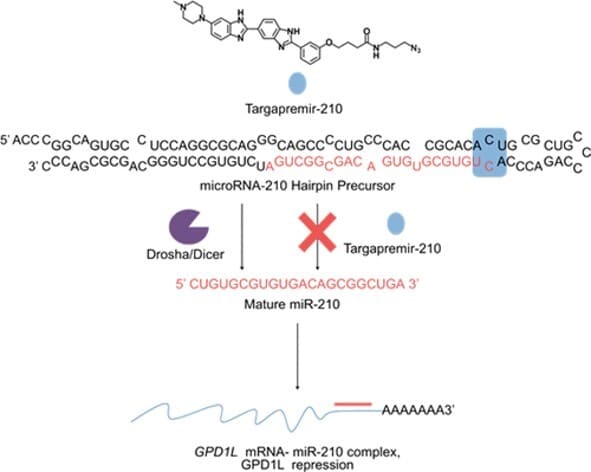
The hypoxic environment within solid tumors is a key driver of cancer aggressiveness and treatment resistance. A critical player in this process is microRNA-210 (miR-210), which is upregulated in hypoxia and supports cancer cell survival. Targapremir-210 is a small molecule that recognizes the Dicer processing site of the miR-210 precursor hairpin. By occupying this functional site, the compound prevents maturation of miR-210, relieving repression of a miR-210 target (GPD1L), lowering HIF-1α levels, and thereby altering hypoxia-driven signaling.
Mechanism of Action
· Target Engagement and Selectivity: The Chem-CLIP approach confirmed that Targapremir-210 selectively engaged the miR-210 precursor in triple-negative breast cancer (TNBC) cells, even in the presence of other RNAs with similar structural motifs.
· Functional Impact: By inhibiting miR-210 production, Targapremir-210 derepressed its target protein, GPD1L. This led to a decrease in the levels of the key hypoxia-inducible factor HIF-1α and, crucially, triggered apoptosis specifically in TNBC cells under hypoxic conditions.
· In Vivo Efficacy: The therapeutic potential was validated in a mouse xenograft model of hypoxic TNBC, where Targapremir-210 significantly inhibited tumorigenesis.
· A Key Insight: The studies revealed that the cellular expression level of an RNA is a major driver of ligand occupancy, explaining how Targapremir-210 could achieve selectivity for its highly abundant target.

