 Alanizi, Aryn A., et al. Bioconjugate Chemistry 35.4 (2024): 517-527.
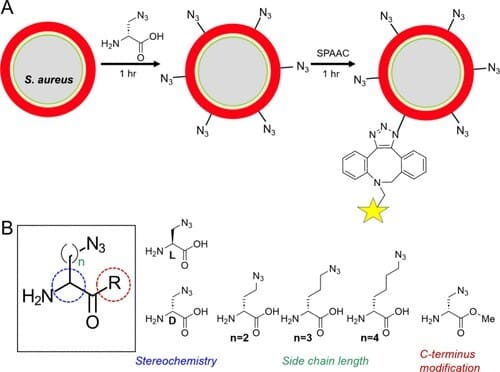
Imaging bacterial infections with PET requires tracers that selectively mark bacteria over host tissue. Incorporation of d-amino acids into bacterial peptidoglycan provides a metabolic route to introduce bioorthogonal handles; 3-azido-D-alanine is an azide-bearing d-amino acid designed to become covalently installed into bacterial cell-wall muropeptides and serve as a reactive handle for strain-promoted alkyne-azide cycloaddition (SPAAC).
Application and Methodology: In this methodology, live pathogenic bacteria, including Staphylococcus aureus, were first incubated with 3-Azido-D-alanine. This allowed the azide-functionalized amino acid to be metabolically integrated into the bacterial cell wall. Subsequently, a water-soluble, [18F]-labeled radiotracer containing a dibenzocyclooctyne (DBCO) group ([18F]FB-sulfo-DBCO) was introduced. The DBCO group undergoes a rapid and selective strain-promoted azide-alkyne cycloaddition (SPAAC) "click" reaction with the azide groups presented on the bacteria, thereby covalently attaching the radionuclide.
Key Findings:
· [18F]FB-sulfo-DBCO was synthesized with high radiochemical yield and purity and functioned as an effective SPAAC reporter for azide-labeled bacterial cell walls.
· Bacteria treated with 3-azido-D-alanine showed significantly higher radiotracer ligation than control cultures treated with D-alanine; for example, Staphylococcus aureus cultures exhibited ~7-fold greater [18F]FB-sulfo-DBCO incorporation when pretreated with 3-azido-D-alanine.
· The tracer's in vivo biodistribution in healthy mice was assessed to provide baseline pharmacokinetic information relevant to eventual infection imaging studies.


 Soto, Paul, et al. Materials Today Bio. (2022): 19.