CAS
136765-55-4 Purity
96%
136765-55-4 Purity
96%


If you have any other questions or need other size, please get a quote.
Specification
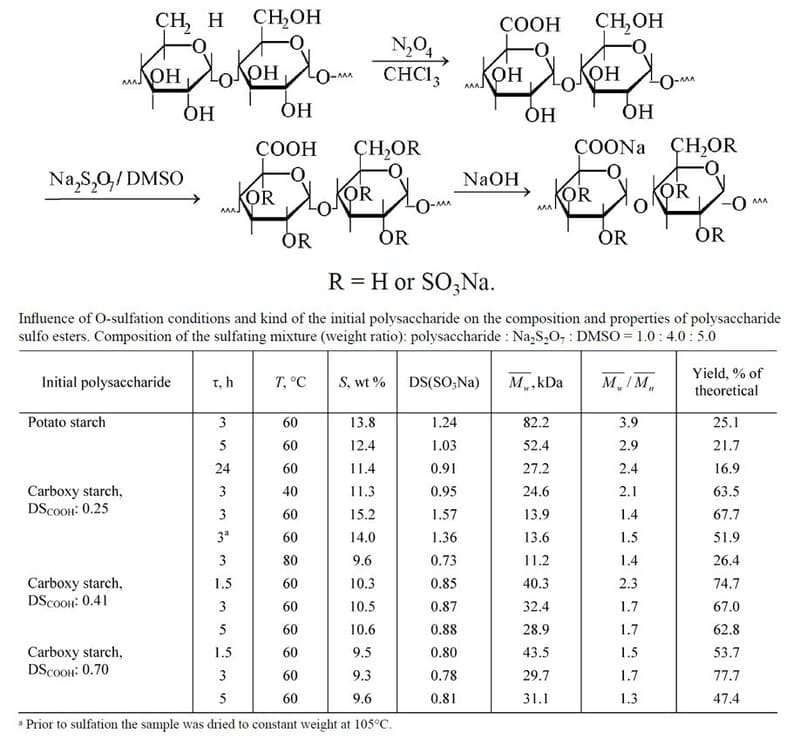 Butrim S M, et al. Russian Journal of Applied Chemistry, 2010, 83, 134-138.
Chemical modification of potato carboxyl starch was achieved in a sodium pyrosulfate-dimethyl sulfoxide system, and water-soluble highly substituted sulfoesters were successfully prepared. In this method, sodium pyrosulfate has low toxicity and is safe to handle compared to the traditionally used sulfatating agents (chlorosulfonic acid and sulfuric anhydride).
Preparation of carboxy starch sulfo esters
· The primary hydroxy groups of the D-anhydroglucopyranose units (AGU) in potato starch was selectively oxidized to form carboxy groups using a solution of dinitrogen tetroxide in chloroform.
· O-sulfation was then carried out as follows: 3 g of the polysaccharide were placed in a flask with a ground-glass stopper, to which sodium pyrosulfate and DMSO were added. The mixture was stirred and allowed to sit at room temperature for 20 minutes.
· Subsequently, the flask was transferred to a water bath and heated to a temperature range of 40-80°C for a duration of 1.5 to 24 hours, with occasional stirring. Once the required time had elapsed, the flask was rapidly cooled, and the contents were poured into 50 ml of ethanol. The resulting precipitate was washed with an additional 100 ml of ethanol, dissolved in distilled water, and the solution was neutralized with a dilute NaOH solution to achieve a pH of 8.5.
· Finally, the target products were obtained through purification steps such as dialysis, washing, concentration and freeze drying. The final samples obtained were amorphous powders, varying in color from white or pale yellow to brown.
 Xiao, Haiping, et al. Catalysts, 2018, 8(11), 541.
A series of sodium salt [sodium sulfate (Na2SO4) and sodium pyrosulfate (Na2S2O7)] poisoning catalysts with different forms and contents were prepared by wet impregnation method, and the effect of sodium salt poisoned catalyst on SO2 oxidation and NO reduction was investigated. The results show that the sodium salt water poisoning catalyst significantly improves the conversion rate of SO2-SO3. Among them, the 3.6% Na2S2O7 poisonous catalyst has the strongest oxidation effect on SO2. The catalyst reached the maximum SO2-SO3 conversion rate of 1.44% at 410 °C.
Preparation of poisoned catalysts based on Na2SO4/Na2S2O7
The poisoned catalysts were fabricated using the wet impregnation method. A specified quantity of sodium sulfate or sodium pyrosulfate was weighed based on the desired mass percentage of sodium (Na) in the active catalyst components. After being dissolved in a solution, the chemicals were combined with the catalysts and subjected to ultrasonic shaking for four hours. Subsequently, the mixture was dried in a blast drying oven at 110 °C for twelve hours. In the final step, the catalysts were calcined in a muffle furnace at 350 °C for five hours and then ground to a mesh size of 40-60, resulting in the x-Na2SO4/Na2S2O7-SCR poisoned catalysts, where x indicates the sodium content in percentage (1.2% or 3.6%).
 Guo, Chunbin, et al. Energy & fuels 27.12 (2013): 7868-7875.
Alumina was extracted from a mixture of circulating fluidized bed fly ash (CFBFA)/pulverized coal ash (PCFA) and sodium pyrosulfate (Na₂S₂O₇) via salt roasting. The effects of sodium pyrosulfate dosage, calcination temperature, and calcination time on the alumina extraction efficiency of CFBFA and PCFA were analyzed and compared. The results showed that the addition of Na₂S₂O₇, CFBFA, and PCFA released alumina, forming Na₃Al(SO₄)₃. When n(Al₂O₃)/n(Na₂S₂O₇) = 1:3, up to 93.3% alumina was extracted from PCFA calcined at 420 °C for 2 h; however, when n(Al₂O₃)/n(Na₂S₂O₇) = 1:5, 92.8% alumina was extracted from CFBFA calcined under the same conditions. Calcination of CFBFA with sodium pyrosulfate formed a new amorphous aluminosilicate phase.
Sodium pyrosulfate was mixed with CFBFA and PCFA in various Al₂O₃/Na₂S₂O₇ solutions. The mixture was placed in a covered alumina crucible and heated in air at different temperatures for different durations, then cooled to room temperature. The CFBFA and PCFA were filtered and washed with distilled water, and the alumina concentration in the filtrate was determined by chemical analysis. All experiments were repeated 10 times, and the mean data were used.
 Kaputskii, F. N., et al. Russian Journal of Applied Chemistry 80.10 (2007): 1745-1749.
Sulfonates of cellulose, dextran, starch, and amylopectin with a degree of substitution of 0.13-1.1 were prepared in a system composed of sodium pyrosulfate and dimethyl sulfoxide. The intrinsic viscosity of the aqueous solution of the sulfonated polysaccharide was determined, and its anticoagulant activity was evaluated.
15g of polysaccharide dried to constant weight was placed in a flask with a ground glass stopper. Sodium pyrosulfate and dimethyl sulfoxide were added sequentially with stirring, and the mixture was heated in an oil bath at a specified temperature for the required time. After the required time, the mixture was neutralized with saturated sodium carbonate solution to a pH of 8-10. Subsequently, the sulfonates were demineralized by dialysis through a cellophane membrane until the qualitative reaction for sulfate ions in the wash water was negative. The solubility of the polysaccharide sulfonates was determined by gravimetric analysis. The purified solution was freeze-dried. The sulfur content of the sulfated polysaccharide was determined by potentiometric titration.
The molecular formula of Sodium pyrosulfate is Na2O7S2.
The synonyms of Sodium pyrosulfate are Sodium Disulfate, Disulfuric acid, disodium salt, Natriumpyrosulfat, DTXSID60889631.
The molecular weight of Sodium pyrosulfate is 222.11 g/mol.
The component compounds of Sodium pyrosulfate are Sodium (CID 5360545) and Disulfuric acid (CID 62682).
Sodium pyrosulfate was created on October 25, 2006.
Sodium pyrosulfate was last modified on October 21, 2023.
The IUPAC name of Sodium pyrosulfate is disodium;sulfonato sulfate.
The InChIKey of Sodium pyrosulfate is JXAZAUKOWVKTLO-UHFFFAOYSA-L.
The CAS number of Sodium pyrosulfate is 13870-29-6.
Sodium pyrosulfate is described as colorless crystals.
Please kindly note that our products are for research use only.
 Download


