CAS
108683-62-1 Purity
97%
108683-62-1 Purity
97%


If you have any other questions or need other size, please get a quote.
Specification
 Dawei Liang. Et al. Mendeleev communications, 2015, 4(25), 252-253.
The deuterium-labeled internal standard drug cefuroxime was synthesized using methoxy-d3-amine hydrochloride through a five-step procedure, which can be used in a wide range of pharmacological studies of cefuroxime.
Synthesis procedure of cefuroxime-d1
· A 66% yield of d3-(2Z)-2-(2-Furyl)-2-(methoxyimino)acetic acid 3 was obtained by reacting 2-(2-furyl)-2-oxoacetic acid 2 with methoxyl-d3-amine hydrochloride in ethanol under reflux conditions for 6 hours.
· The resulting compound 3 was then converted to acid chloride 4 using oxalyl chloride in the presence of DMF, and without purification, acid chloride 4 was used in the acylation of 7-ACA in dichloromethane with DIPEA, yielding amide 5 in 67% yield.
· Hydrolysis of the ester group in 5 was achieved by treatment with NaOH at temperatures below -20°C for approximately 5 hours.
· Further experimentation showed that acid 6 could undergo intramolecular esterification to form lactone 7 when neutralization was carried out at room temperature. By reducing the workup temperature to below -20°C, a 73% yield of hydroxy acid 6 was obtained, thus improving the overall efficiency of the reaction.
 Yang, S.; Liu, L.; Gerson, S. L.; Xu, Y. Journal of Chromatography B, 2003, 794, 295-307.
Methoxyl-d3-amine hydrochloride (CD3ONH2.HCl, CDN Isotopes, lot G582P1) served as the deuterated internal standard throughout a tandem mass spectrometric assay for the anti-cancer agent methoxyamine in plasma.
Working internal standard solution was made to 60.0 ng/mL CD3ONH2 by three-step dilution (1/100, 1/100, 1.038/10) of a 10.0 mg/mL aqueous stock, and 50.0 microL of this solution was added to each 150 microL plasma sample together with deionised water and 50.0 microL of 10.0 mg/mL 4-(N,N-diethylamino)benzaldehyde derivatizing reagent; the mixture was then heated at 80 degC for 1 h and centrifuged for 5 min.
Extracts were cleaned on a Waters Oasis HLB column (2.1 mm x 20 mm) loaded with water at 2.0 mL/min, and eluted with 95% acetonitrile + 5% water at 0.6 mL/min, giving a total run time near 5.0 min and allowing more than 300 extractions per column when stored in 50% acetonitrile.
Selected reaction monitoring followed the transition m/z 207 > 149 for the methoxyamine derivative and m/z 210 > 149 for the methoxyl-d3-amine derivative, with argon collision gas at 2.0-2.5 x 10^-3 bar, cone 34 V, collision energy 20 V, dwell 0.3 s and source at 70 degC; a 1:5 post-column split delivered about 100 microL/min to the electrospray source.
Plotting analyte-to-internal-standard peak-area ratio against concentration gave linearity over 1.00-1000 ng/mL in human plasma with a correlation coefficient of 0.9999 and a mean calibration equation y = 0.0579x (slope CV 2.4%, n = 3 over one month).
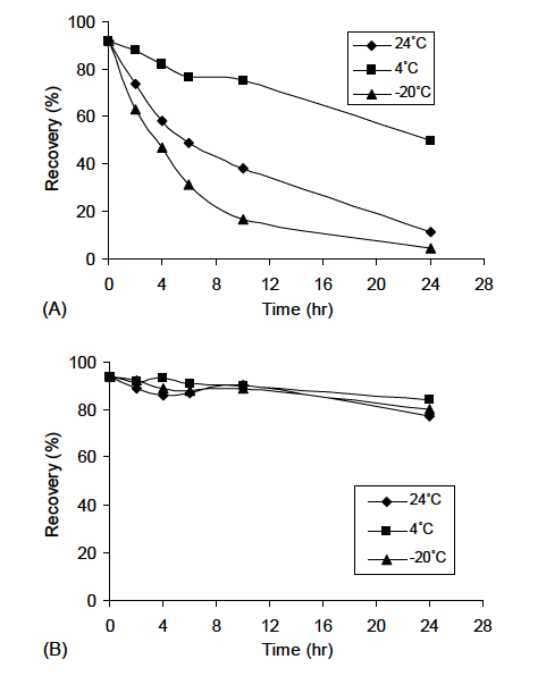
Accuracy was 95.0, 90.1 and 96.3% and recovery 90.1, 91.4 and 94.7% at 5.00, 50.0 and 500 ng/mL respectively, while intraday and interday imprecision across the three levels were below 4%; the calculated LOD and LOQ were 0.150 and 0.500 ng/mL.
A mouse disposition study then applied the method after single intraperitoneal doses of 2, 5 and 20 mg methoxyamine hydrochloride per kg.
 Yang, S.; Savvides, P.; Liu, L.; Gerson, S. L.; Xu, Y. Journal of Chromatography B, 2012, 901, 25-33.
Methoxyl-d3-amine hydrochloride from C/D/N Isotopes was converted into the internal standard MX-d3 for a fully validated LC-MS/MS determination of methoxyamine in human plasma supporting a first-in-human phase I trial.
A 2.00 mg/mL stock was prepared by dissolving CD3ONH2.HCl in 0.100 N hydrochloric acid applying a mass correction factor of 0.579, then serially diluted to a 100 ng/mL working solution; 75 microL of this was combined with each 150 microL plasma aliquot, 50 microL of 500 microg/mL 4-(N,N-diethylamino)benzaldehyde and 150 microL of 4% phosphoric acid, followed by heating at 70 degC for 1 h.
After methyl tert-butyl ether liquid-liquid extraction, the derivatives were resolved isocratically on a 2.1 x 100 mm Xterra C18 column with 45% acetonitrile plus 0.4% formic acid at 0.200 mL/min, and quantified by positive turbo-ion-spray MRM using m/z 207 > 178 for derivatized methoxyamine and m/z 210 > 181 for derivatized methoxyl-d3-amine.
Validation covered MX calibrators of 1.25, 2.50, 5.00, 12.5, 25.0, 50.0, 125, 250 and 500 ng/mL prepared so that each contained exactly 90% plasma, giving a linear range of 1.25-500 ng/mL with correlation coefficient at least 0.9993.
Quality controls at 3.50, 45.0 and 450 ng/mL returned intra-assay imprecision of 0.9-1% and inter-assay imprecision of 0.8-3%, and a dilution QC of 1.50 x 10^3 ng/mL diluted fivefold with blank plasma also met acceptance criteria.
Matrix effect and selectivity were established using six individual blank plasmas (1M2070-01 to 1M2070-06) and six pre-dose patient plasmas, and MX proved stable under every condition tested; TMZ-containing QCs prepared at 20.0 microg/mL confirmed there was no interference, and the assay was then applied to patient plasma concentration-time profiles.
The molecular formula is CH6ClNO.
The synonyms are Methoxyl-d3-amine Hydrochloride, O-(Trideuteriomethyl)hydroxylamine;hydrochloride, Methoxyamine-d3 (Hydrochloride), and Methoxyl-d3-amine HCl.
The molecular weight is 86.53 g/mol.
The parent compound is Methoxy-d3-amine.
Yes, Methoxyl-d3-amine Hydrochloride contains Methoxy-d3-amine and Hydrochloric Acid as component compounds.
Methoxyl-d3-amine Hydrochloride was created on February 1, 2011.
Methoxyl-d3-amine Hydrochloride was last modified on October 21, 2023.
The IUPAC Name is O-(trideuteriomethyl)hydroxylamine;hydrochloride.
The InChIKey is XNXVOSBNFZWHBV-NIIDSAIPSA-N.
The CAS number is 110220-55-8.
Please kindly note that our products are for research use only.
 Download


